9 September 2025
How online learning boosts EDI training to support diversity goals

Natalie Ann Holborow
Content Marketing Manager
Take EDI training to new levels by harnessing the power of a learning management system.
Equality, diversity and inclusion (EDI) training is an important part of any organisation’s commitment to its employees, members or users.
EDI training doesn’t have to involve a huge commitment of time and resources. Using online learning can help you reach your EDI goals more effectively.
In this article, we’ll look at some of the key ways in which online learning can boost EDI training and support wider diversity initiatives.
Sharing consistent training
A learning management system makes it easy and cost-effective to reach all of your team with consistent DIEP training.
Whether you’re using SCORM packages for high-quality off-the-shelf learning content or custom learning content, you can have confidence that everyone is getting the same message about diversity and inclusion.

Tracking training completions
Having shared consistent EDI training content with your team, you can easily track who has and who hasn’t completed their diversity training. This streamlines your processes for ensuring everyone undertakes mandatory training.
It also proves that people were made aware of the organisation’s expectations of them. If an issue arises, you have transparency and accountability. Nobody can claim they didn’t know about inclusion policies if you can clearly show they completed the same inclusion training as the rest of your team.
Reaching new audiences
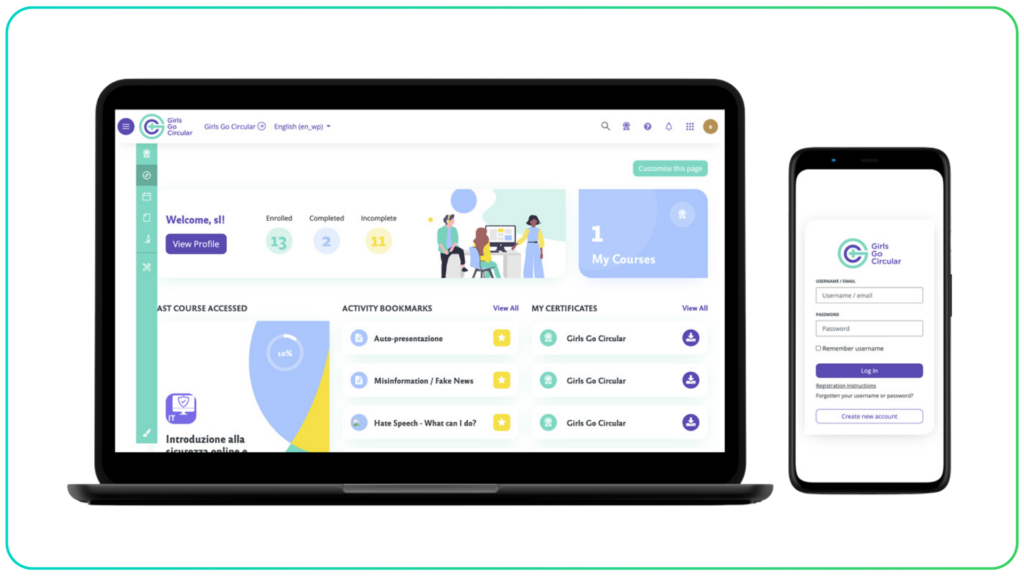
Online learning removes geographic, economic and scheduling barriers to make learning more widely accessible. This inevitably can be used to support efforts to improve inclusion.
Using its Moodle Workplace LMS, the Girls Go Circular initiative delivered STEM skills training to tens of thousands of schoolgirls across southern and eastern Europe.
The EU-funded project is empowering young women to redress the gender gap in STEM professions. It’s a great example of how online learning can be used to make targeted interventions to increase inclusion, even when those interventions involve a large audience across a wide geographic area.
Removing unconscious bias
Delivering learning via an LMS helps to eliminate biases — unconscious or otherwise — that might otherwise impact learning experiences. To your LMS, all learners are equal. No differentiation is made based on gender, age, physical appearance or any other attributes beyond those being assessed.
An excellent case in point is the United Nations Department of Safety and Security (UNDSS), which is responsible for training UN bodyguards. By using its Totara LMS to complete theory training, UNDSS eliminates any bias about who looks like they would be a good bodyguard. Instead, candidates are selected based solely on being able to demonstrate their aptitude for close protection work.
The result has been a significant increase in the number of female close protection officers joining UNDSS. This is partly due to the elimination of unconscious bias, but equally because women candidates now apply with the confidence that they will be able to prove their suitability ahead of the physical training.
UNDSS trainers say the result is a higher quality of close protection training candidates. As well as increasing equality, diversity and inclusion, this also has a cost-benefit. In-person bodyguard training is very expensive. Increasing the standard of candidates progressing from the LMS to physical training is very cost-effective for UNDSS.
Improving accessibility
LMS accessibility benefits everyone. It encourages diversity and inclusivity. With the technology available, it’s now easier than ever to create meaningful learning experiences that are customised to the needs of each learner.
This includes enabling your team to learn at their own pace, creating a multilingual LMS, and incorporating accessibility tools.
Creating cross-cultural exchanges
An LMS creates opportunities for communication and exchange of ideas across different countries, cultures and languages.
Plan International can encourage conversation, collaboration and best practices among team members who wouldn’t normally have contact with each other. Even employees in remote locations can share and gain knowledge from their colleagues worldwide.
Similarly, the Wildfowl and Wetlands Trust shares conservation best practices globally. Its Totara LMS is a focal point for knowledge-sharing and discussions among conservation communities across Indo-Burma, Madagascar and West Africa.

Sharing meaningful EDI data
Integrating your LMS and HR system makes it easy to get measurable, actionable EDI data from your LMS. Track when engagement and learner outcomes are disproportionately affected by demographics. You can then take steps to identify why and put measures in place to address the issue.
Save the Children uses Totara’s powerful reporting system to share learning analytics with each department, plus training leaders in different countries. This means all managers have the data to monitor their team’s progress and prepare reports for auditing.
Boost EDI training with your LMS

Ready to get more from your EDI training and achieve your equality targets? Talk to our team of learning technology experts to find out how your LMS can support this.
Get in touch today.