
24 November 2026
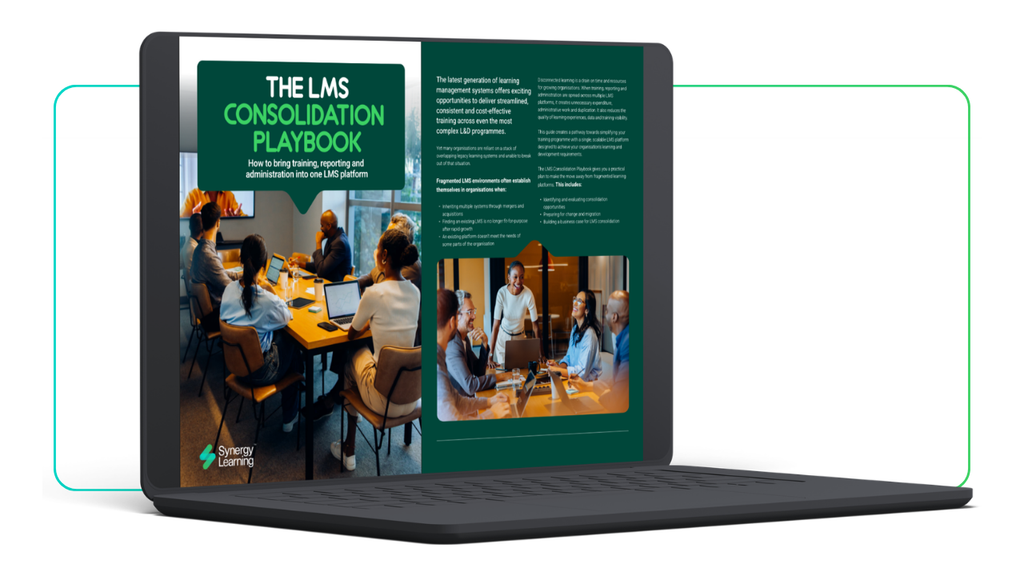
The LMS consolidation playbook

Becky Henson
Customer Success Manager
How to bring training, reporting and administration into one platform.
Running training across several overlapping learning systems drains time, budget and data quality. Download the full LMS Consolidation Playbook to learn how to audit your learning landscape, decide the future role of every platform, define the requirements for a single scalable LMS, migrate your data safely, and build a financial business case that wins senior backing.
What is LMS consolidation?
LMS consolidation means moving training, reporting and administration from several overlapping learning systems onto one scalable platform. Organisations usually end up with multiple systems after mergers and acquisitions, rapid growth that outpaces an existing LMS, or a platform that doesn’t meet the needs of some parts of the business. A single LMS cuts duplicated admin and costs, makes learner experiences consistent, and gives L&D one reliable view of training and compliance.
How do you know your learning environment is fragmented?
If several of these signs apply, your organisation would likely benefit from LMS consolidation:
- ✳️ Multiple LMS platforms serve different departments, regions or business units.
- ✳️ Functionality overlaps across those systems.
- ✳️ User, course and reporting admin takes a heavy workload.
- ✳️ Learning experiences are inconsistent from one platform to the next.
- ✳️ There is no single, reliable view of learning activity and performance.
- ✳️ Licensing and running costs are spread across and rising on several platforms.
- ✳️ Legacy platforms no longer meet organisational requirements.
Staying fragmented has a price: time wasted on admin, duplicated tasks and functionality, complicated renewals and upgrades, inconsistent training, and unreliable or disconnected L&D data.
What are the benefits of LMS consolidation?
Bringing every part of your L&D programme into a single platform gives your organisation the chance to:
- ✅ Reduce LMS administration costs
- ✅ Increase operational efficiency
- ✅ Remove duplicated tasks and expenditure
- ✅ Deliver more consistent learner experiences
- ✅ Improve reporting and visibility across the organisation
- ✅ Integrate more effectively with HR and other business systems
- ✅ Scale and adapt as the organisation changes
How do you audit your LMS landscape?
Start by auditing every learning system in your organisation, including informal tools and workarounds such as spreadsheets and legacy platforms.
Keep the tone constructive: the audit should make life easier, not feel like an inquest, so people talk freely about how training really runs.
The full guide gives you the four-step audit framework, plus a ready-to-use template for recording each platform’s users, costs, renewal dates, gaps and recommendation.
Then use the guide’s decision framework to give every platform a future role, whether that means keeping it, replacing it or folding it into a single LMS.
What features should a consolidated LMS offer?
Your requirements depend on your organisation, but five capabilities come up most often in consolidation projects:
- ✳️ Multi-tenancy. Create separate learning environments for departments, divisions or learner groups inside one LMS installation, all managed centrally.
Plan International used a multi-tenancy Totara LMS to bring training for 18,000 learners in more than 70 countries onto one consistent platform, with reporting and compliance managed globally. - ✳️ Flexibility and scalability. Choose a platform that can adapt as your organisation changes. The British Institute of Learning Disabilities (Bild) consolidated two learning systems into a single Moodle LMS so it could scale and adapt over time.
- ✳️ Single sign-on. Learners use the same credentials as other business systems, which improves access and means fewer forgotten-password requests.
- ✳️ Automation. Integrate your LMS with your HR system so user details update automatically, and automate enrolment, learning pathways, certification, expiry, recertification and reporting.
- ✳️ Accessibility. Consistent interfaces, easier sign-on and localised language settings make a single LMS more accessible than several platforms.
Fintech business Bravura Solutions shows how it happens in practice: after two years running Totara alongside other platforms, it moved all its learning audiences onto Totara and gained greater visibility and control over training.
Full or phased LMS consolidation?
Choose the approach that minimises disruption to training and compliance and avoids unnecessary spend.
- ✳️ Full consolidation moves all learning to one LMS in a single step. It suits organisations with an urgent security risk, contracts ending across all current platforms, or significant duplication to remove.
- ✳️ Phased consolidation moves divisions, departments or learner groups in stages. It suits large or complex organisations, platforms with different renewal dates, and teams that want to lower the risk of a major transition.
Engage stakeholders early, ideally during the audit, so you understand how each system is used and earn buy-in.
Data migration is a common reason organisations stay fragmented, but careful planning removes the risk of lost or corrupted records. The full guide sets out an eight-step migration process, from deciding which data to keep to completing the move without disrupting learners.
How do you build the business case for LMS consolidation?
Senior leaders respond to financial and strategic return, so set aside the daily frustrations of fragmented learning and show what a single LMS will save. Three calculations make the case.
The full guide gives you the formulas, and the figures to gather, for each of these calculations:
- ✳️ Platform and licensing costs: annual recurring savings and the payback period on your investment
- ✳️ Administration costs: the annual value of admin hours saved through automation and fewer duplicated tasks
- ✳️ Auditing costs: the saving per audit from having compliance data in one place
Then set out the long-term gains: lower regulatory risk through automated compliance, higher productivity for L&D and HR teams, better visibility of training, and a scalable learning infrastructure that grows with the organisation.
LMS consolidation FAQs
What does it mean to consolidate an LMS?
It means bringing training, reporting and administration from several learning platforms into one scalable LMS, so there is one place to deliver learning, track compliance and report.
When is a phased approach better than full consolidation?
A phased approach suits large or complex organisations, platforms with different renewal dates, and teams that want to reduce the risk of a major transition. Full consolidation suits urgent risks, contracts that end together, or heavy duplication.
Is it safe to migrate learning data to a new LMS?
Yes, with careful planning. Poor planning can lead to lost records, disrupted learning and compliance issues, which is why the full guide sets out an eight-step migration process.
How do you win senior leadership support?
Focus on return on investment: lower platform and licensing costs, annual admin savings, cheaper auditing, and long-term benefits such as lower regulatory risk and better visibility of training. The full guide gives you the formulas to prove each one.
Can you consolidate onto Moodle or Totara?
Yes. Bild consolidated two systems onto a single Moodle LMS, and Plan International and Bravura Solutions each moved their learning onto Totara.
Download the full guide to learn more
This article explains why consolidation matters. The full LMS Consolidation Playbook shows you how to do it, with the frameworks, templates and formulas to plan your move and win budget. Inside the guide:
- ✅ A ready-to-use consolidation audit template
- ✅ The four-step LMS infrastructure audit framework
- ✅ A decision framework for every platform in your landscape
- ✅ A requirements framework covering learner experience, administration, integrations, scalability and reporting
- ✅ An eight-step data migration process
- ✅ Business case formulas for platform costs, admin time and audit savings
- ✅ An eight-point checklist to keep your project on track
Download the full guide to learn more
Synergy Learning is a Moodle Premium Certified Partner and Totara Platinum partner, helping ambitious organisations choose, implement and support learning platforms since 2005.