
29 June 2026
What features are essential in an LMS for regulated industries like healthcare or finance?

Natalie Ann Holborow
Content Manager
Explore everything you need to consider when choosing a regulated industry LMS for your organisation.

Working in a regulated industry often means being held to higher levels of scrutiny and accountability than your peers in unregulated industries. Certainly, that’s true of learning and development.
L&D in regulated industries means achieving stringent, often very specific compliance training requirements – and being able to prove you’re doing so. Against that backdrop, LMS specifications differ dramatically in regulated industries.
Choosing an LMS for regulated industries is not just a straightforward learning technology decision, as it is for many organisations. It’s about choosing an enterprise LMS that’s equipped to handle the various compliance, governance and risk-management considerations of any regulated organisation.
Learning management systems in regulated industries still have to deliver the right learning experiences, be easy to manage and deliver good value for money. But L&D professionals, compliance directors, risk leads and senior leadership teams need a learning platform that also addresses key considerations around governance, risk and accountability.
Can you instantly show that your workforce is compliant? Can you prove to a regulator exactly who completed which training, when and to what standard? Can you track compliance rates proactively and in real-time?
Failing to put regulation at the heart of any LMS selection process risks causing considerable reputational and financial damage. With regulatory scrutiny increasing across most major industries, it’s becoming increasingly important to choose the best LMS to achieve compliance targets and meet regulatory requirements.
Drawing on more than two decades’ experience of creating learning platforms for organisations in tightly regulated industries, in this article, we will look at everything you need to think about to guide you towards the right LMS for your regulated organisation.
What makes an industry ‘regulated’?
A regulated industry is any sector in which all or some aspects of the work are governed by a set of standards or quality requirements that are outlined, and often enforced, by an independent regulatory authority. This is typically in industries in which public safety is at stake. But an industry may also be regulated to protect consumers, prevent monopolies or guarantee product quality.
Regulated industries include:

Healthcare
NHS and other providers need a healthcare LMS that supports strict regulations around patient safety, mandatory clinical training and professional registration.

Pharmaceuticals
Pharmaceutical organisations must deliver training to meet Medicines and Healthcare Products Regulatory Agency regulations around public safety, clinical trials, safety monitoring and other aspects of manufacturing.

Finance
Financial services organisations need a finance LMS that meets compliance requirements governed by the Financial Conduct Authority and other regulators.
Manufacturing
Manufacturing organisations typically need an LMS to meet health and safety obligations, plus competency management.

Public sector and government
A public sector or government LMS must support statutory training, governance obligations, data security requirements and sector-specific compliance frameworks.

Energy and utilities
Regulated energy and utilities suppliers need to deliver training that meets the regulator’s requirements, manages operational risk and certifies their workforce.
Essential LMS features for regulated industries
While every regulated industry has specific L&D requirements, there are some features and functionality that are vital for all regulated organisations. Some of the top LMS features for regulated industries include:
Mandatory training management
To meet strict compliance training obligations, L&D professionals in regulated industries must deliver mandatory training to a large number of learners. Whether it’s NHS statutory training, anti-money laundering programmes in financial services, or health and safety training in manufacturing, an LMS for regulated industries needs to streamline processes to ensure that all employees get the right training at the right time.
It can achieve this through:
- ✅ Automated enrolment onto the LMS based on each learner’s role, department or location
- ✅ Role-based assignment of mandatory training
- ✅ Compliance tracking and escalation processes
- ✅ Integration with HR and workforce management systems
This helps regulated organisations to cut their administrative burden and unsustainable manual processes, while also ensuring compliance requirements are applied consistently across even a large and dispersed workforce.
Integration with key business systems
To meet those requirements for automated enrolment and role-based assignment, a successful regulated industry LMS must integrate with other business systems. This is important because an LMS doesn’t operate in isolation from other aspects of regulatory requirements. Learning delivery and reporting typically form part of a wider governance and compliance infrastructure.
For organisations wanting to speed up automated processes, maintain reliable data and increase security within a regulated environment, key LMS integrations include:
- ✅ HR systems
- ✅ Enterprise resource planning (ERP) platforms
- ✅ Identity Management (IdM) or Identity and Access Management (IAM) systems
These integrations help to remove manual processes, cut duplication and reduce compliance risk. They all ensure training records are always accurate and reflective of real-time data from across the organisation.
Role-based access and permissions
Once role-based data is integrated with your LMS from other business systems, it’s vital that the LMS offers role-based settings that not only improve L&D but also support wider regulatory requirements. This includes:
- ✅ Security controls to restrict access
- ✅ Managing data governance
- ✅ Providing – and restricting – key data to relevant departments
Governance and approval workflows
LMS infrastructure also creates a framework for approval workflows. This is another essential data governance feature for regulated industries. LMS approval workflows enable:
- ✅ Manager approvals to support team-level compliance
- ✅ Multi-level sign-off throughout the organisational hierarchy
- ✅ Customisable governance controls
- ✅ Audit trails for decision-making processes
Tighter governance helps organisations to ensure – and prove – that regulatory processes are followed consistently and transparently.
Certification and recertification
rtifications are kept up to date to maintain operational standards, reduce risk exposure and avoid regulatory action.
For that reason, a compliance training LMS must help an organisation to oversee, streamline and automate its certification processes. Key LMS compliance features involving certification include:
- ✅ Expiry tracking for mandatory training certification
- ✅ Automated reminders to learners ahead of expiry
- ✅ Renewal and recertification workflows based on roles and regulatory requirements
In practical terms, this could involve certifying regular competency assessments for healthcare workers, operational competency recertification for manufacturing and other safety-critical industries, and ongoing conduct and regulatory training in financial services.
To discuss how any of these features would support your compliance goals or help you to achieve your regulatory requirements, book a consultation with one of our LMS experts.
Compliance tracking dashboards
ompliance teams and L&D professionals all need to be able to assess organisational compliance performance immediately.
Achieving accurate and effective compliance management requires a learning platform that offers:
- ✅ Organisation-wide visibility of compliance
- ✅ Easy risk identification
- ✅ Ongoing compliance status monitoring
This means at-a-glance dashboards detailing key metrics, such as:
- ✅ Completion rates
- ✅ Certification status
- ✅ Expiring qualifications
- ✅ High-risk departments
- ✅ Overdue learning activities
Tracking key compliance statistics using dashboards enables organisations to identify compliance risks and act before they become regulatory issues.
Audit-ready reporting
Compliance tracking is incredibly useful for L&D teams. But that same employee training compliance data also needs to be quickly available to regulators. In fact, this is perhaps the most important of all LMS compliance features.
An LMS for regulated industries must deliver the agility, accuracy and accountability needed for an audit – and ensure that this is an easy and streamlined process for LMS admins. That means:
- ✅ Real-time reporting on compliance and other key metrics
- ✅ Complete evidence trails that can easily be accessed and shared with auditors
- ✅ Historical training records
- ✅ Regulator-ready records to document compliance
An LMS for a regulated industry must be able to deliver an instantaneous overview of who completed specific training, when it was completed, what version of the training was completed, their assessment results and their certification status.
CPD tracking
Continuing professional development (CPD) and compliance are often closely linked in regulated industries. CPD tracking is often key for proving that employees have achieved milestones. An LMS needs to offer:
- ✅ Professional development records
- ✅ Accreditation support
- ✅ Evidence collection
Multi-region and multi-regulation support
gulators. Against that backdrop, an LMS for regulated industries needs to cater to different audiences, usually in the form of a multi-tenancy LMS. This creates the infrastructure to match:
- ✅ Different compliance frameworks
- ✅ Specific requirements across a global workforce
- ✅ Local regulatory variations
For example, a multinational financial services business may need to manage different – but equally demanding – regulatory requirements across jurisdictions. Similarly, a healthcare provider or pharmaceutical company might need its learning platform to align with different accreditation frameworks in different jurisdictions.
Why reporting and audit readiness matter
In any regulated industry, complying with regulations is only half the battle. If you can’t also prove compliance, your organisation is still at risk of sanctions. That’s why, as we outlined above, LMS reporting and audit readiness are critical.
Being prepared for regulatory inspections or internal audits offers peace of mind to L&D professionals and senior management. It also means that governance requirements are always being met proactively, rather than reactively.
Learning management systems that are equipped with the features and functionality to meet these needs have the potential to save a lot of time, money and resources – not to mention headaches – for L&D teams. Crucially, it also means that compliance data is always available at a glance and ready for closer scrutiny at a moment’s notice, without the need for panic or upheaval. Preparing for audits doesn’t cause as much disruption or require so much effort.
Information on your compliance training programme and other data contained within your LMS might be needed for regulatory inspections, internal audits or board-level governance reporting at very short notice. With the right learning platform in place, the relevant data can be quickly accessed and a report created or scheduled.
The LMS also becomes a storage system for historical data, so that past compliance records can easily be accessed if they’re needed.
By maintaining accurate, accessible and verifiable training records, organisations can reduce audit preparation time, identify compliance gaps earlier and demonstrate stronger organisational control.
Open-source LMS platforms for regulated organisations
For regulated industries, open-source learning management systems typically offer the versatility to meet complex or changing regulatory requirements.
A good example of this is enterprise LMS Totara, which helps regulated organisations reduce risk, upskill staff and deliver compliance training at scale. By automating onboarding, mandatory training pathways and other role-based learning, it quickly and efficiently meets the L&D needs of large organisations. This saves time and money on admin, while also delivering consistent learning to all employees.
From a compliance perspective, Totara helps organisations adopt proactive risk control, rather than reactive compliance management. Automated certification tracking, recertification workflows, reminders, and audit-ready reporting help to boost compliance while also supporting regulatory and operational requirements. This reduces compliance risk and the cost of audit preparation.
Its powerful reporting system gives detailed and at-a-glance insights into compliance status, learning engagement and workforce readiness. This includes at team, departmental and organisation-wide levels. With role-based settings and multitenancy functionality, Totara also enables comprehensive and manageable governance, faster identification of compliance gaps and better decision-making.
Another open-source LMS option is Moodle, which offers the flexibility to meet the varied needs of regulated industries. This enables organisations to design learning and compliance processes that meet specific regulatory, operational, and governance requirements. This avoids the awkward alternative of trying to bend learning technologies to meet those requirements.
Open-source platforms can be extended or adapted to deliver specific features or functionality. Moodle, with its open architecture, is a particularly strong example of this. It can be configured to support complex compliance workflows, certification processes and governance requirements. It also creates opportunities to integrate learning and compliance data with wider business systems, plus a broad ecosystem of open-source add-ons.
Both of these aspects of customisation ensure a Moodle LMS can be tailored to deliver the precise user experience, workflows, reporting and learning pathways that an organisation wants to create. Equally importantly, it means these can be updated over time without the need to invest in a completely new LMS.
We’ve been Premium Moodle Partners since 2005 and Platinum Alliance Totara Partners since 201, recently Synergy Learning were named as Totara Global partner of the year 2026.
As such, we have considerable experience of configuring both platforms to meet regulatory requirements, reporting needs and long-term compliance strategies.
Choosing the right LMS partner
Selecting an LMS for regulated industries isn’t just about picking the right platform. It’s also about finding an LMS partner with the implementation expertise to achieve the learning outcomes needed in complex, regulated environments. The LMS compliance features we’ve mentioned already count for little if they’re not set up and customised to meet the needs of the organisation.
That’s especially true with an open-source learning platform, which can be implemented by just about anyone – but not necessarily to the standards needed. Regulated organisations need an LMS partner capable of a detailed discovery process to fully understand the needs of their organisation and the wider sector.
The right LMS partner will use these requirements as the basis for governance, workflow and reporting strategies, then customise the learning platform to meet those needs. Clients with regulatory requirements to meet also often need long-term support to meet changing needs over time.
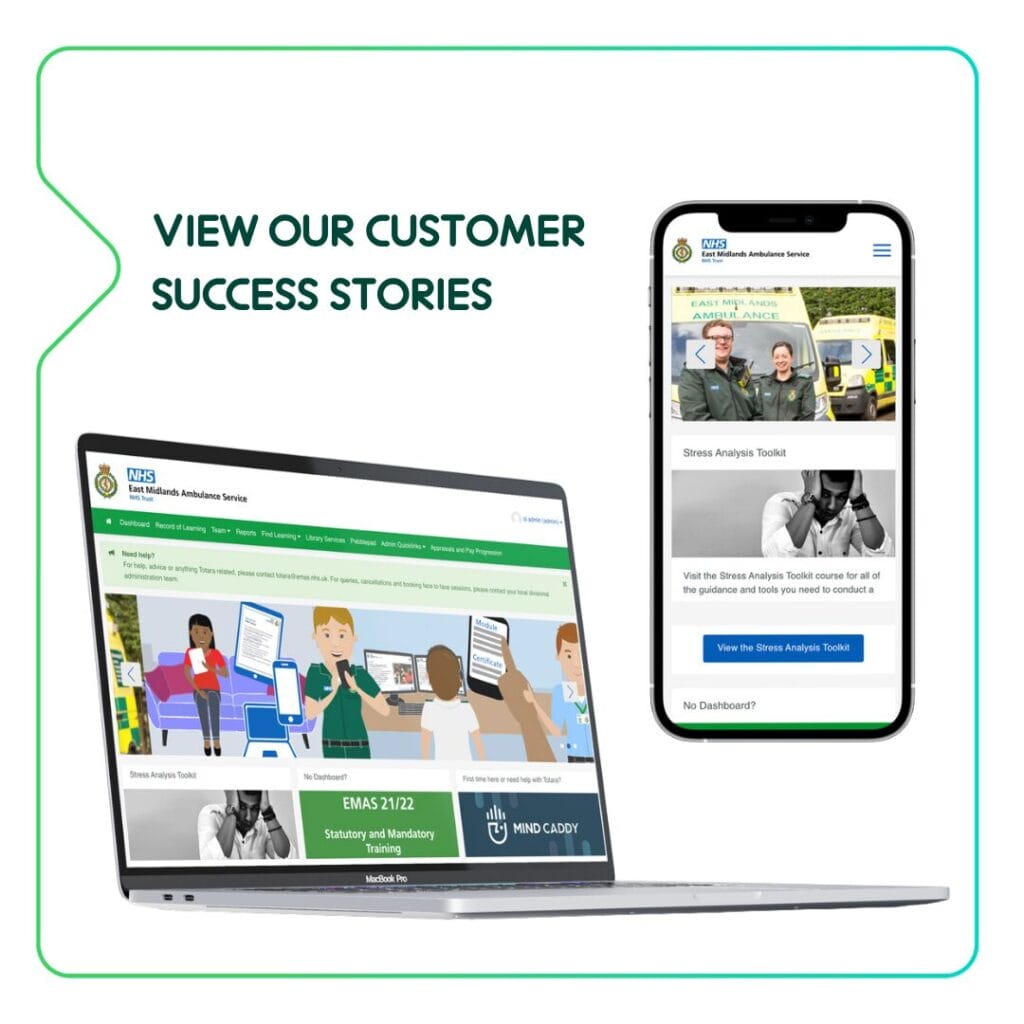
That’s the approach we’ve been taking across more than 20 years of developing learning management systems for regulated industries. Over the course of a long-term partnership, we’ve helped East Midlands Ambulance Service to increase compliance rates from around 50% to 98%. This was predominantly achieved by putting in place LMS compliance features that reduced paper process and time-consuming administrative tasks.
By understanding and responding to the complex compliance needs of an organisation like the Office for Nuclear Regulation, we’ve achieved 100% learner engagement.
Similarly, we helped Western Union to develop the sophisticated workflows and reporting needed to reach 500,000 agents worldwide with new compliance training. Its Totara LMS streamlines processes while also meeting varying financial services regulations across the hundreds of jurisdictions in which it operates.
In our experience, implementing an LMS that’s designed for effective compliance management should include:
- ✅ Discovery workshops
- ✅ Mapping of regulatory requirements
- ✅ Governance design
- ✅ Workflow configuration
- ✅ Tailored reporting strategy
- ✅ Change management processes
- ✅ Ongoing support and optimisation
Questions to ask regulated industry LMS partners
To help your search for the right LMS partner, it’s important to make sure they have a detailed understanding of the requirements of employee training compliance and certification management in a regulated environment.
To do this, ask potential LMS partners:
- ✳️ How do your learning management systems manage certification expiry?
- ✳️ Can LMS reporting be customised for regulatory audits?
- ✳️ How are governance workflows configured within the LMS?
- ✳️ How does the platform support multiple regulatory frameworks?
- ✳️ What experience do you have of delivering learning management systems in regulated sectors?
Discuss your compliance-led LMS requirements
If your organisation operates in a highly regulated industry, choosing the right LMS is critical for compliance, governance and managing financial and reputation risk.
Book a call with one of our e-learning experts for guidance on how an LMS could support your compliance, governance and learning management requirements.