
19 November 2026
How an LMS platform supports competency frameworks in regulated industries
In highly regulated industries, mandatory training is necessary, but not sufficient for understanding whether your staff are prepared to perform their roles safely and effectively. An organisation also needs to assess whether employees have the skills, experience and knowledge to do their jobs well and comply with the relevant regulations.
For example, a healthcare professional might have earned an online certification in infection control, but lack the skills and experience to apply their knowledge in practice.
Similarly, a manufacturing technician might need to demonstrate proficiency with specific machinery before they’re allowed to work independently. This means implementing methods such as practical assessments, workplace observations and supervisor sign-offs to verify that employees can apply their knowledge and skills to the required standard.
Competency frameworks help to outline these expectations in a structured way, but can be challenging to scale across thousands of employees without the right tools; this is where a learning management system (LMS) comes in.
Using an LMS as a centralised platform for assigning learning materials, assessing competency, monitoring progress and recording evidence, organisations can understand employee competencies and deploy talent effectively, all in accordance with their industry’s laws and regulations.
In this article, we’ll examine how learning management systems such as Totara and Moodle Workplace can support competency frameworks in highly regulated sectors.
What is a competency framework?
Competency frameworks define the knowledge, skills, behaviours and abilities that people need in order to perform tasks or roles to the required standard (whether that standard is set by the organisation or industry regulation).
Organisations can implement these frameworks to set consistent, objective expectations and criteria, allowing them to rigorously assess and monitor employee capabilities.
Typically, a competency framework might include:
- ✅ Competencies: These represent the individual skills and behaviours required for an employee to perform their role or a specific activity.
- ✅ Proficiency levels: Any given competency can have multiple levels of proficiency; for example, you may want to differentiate between users who can perform a task independently and those who can only perform the task with supervision.
- ✅ Assessment criteria: The methods you use to determine whether each individual meets the required standard for a competency.
- ✅ Development requirements: The learning activities (e.g. completing a course or certification) and practical experience that can help individuals achieve a specific proficiency level.
- ✅ Review periods: How often you need to reassess competency for relevant skills to ensure employees maintain proficiency and stay up to date with changing regulations and working practices.
A carefully designed competency framework creates consistency across your workforce, helping to identify skill gaps that need to be addressed and guiding professional development for employees.
Why are competency frameworks important in regulated sectors?
For organisations operating in highly regulated sectors, workforce competency can have significant implications for safety, service quality and regulatory compliance. Financial services organisations need their specialists to understand financial regulations, while manufacturing businesses need to ensure that their technicians are able to operate heavy machinery safely.
By creating an organisational competency framework, these businesses can define these requirements in a structured way, and implement standardised methods to assess proficiency.
A well-designed competency framework addresses several important challenges:
- ✅ Inconsistent standards: Different parts of the organisation may apply different standards to employees performing similar roles, meaning skill sets aren’t interchangeable between locations or teams.
- ✅ Limited visibility: Managers may struggle to identify competent staff for specific tasks and competency gaps may go unaddressed.
- ✅ Fragmented records: When training and assessment records are spread across various spreadsheets and systems, auditing and proving compliance become significantly more difficult.
- ✅ Changing requirements: Competency standards need to be continually updated as regulations and technologies change over time.
For larger organisations, these problems become more difficult to solve as the workforce scales and responsibilities become more specialised.
A competency framework provides the foundation for consistent competency management, then an LMS puts that framework into practice.
How can an LMS support competency frameworks?
An enterprise learning management system provides the tools to connect your competency requirements with learning and assessment, as well as wider workforce development.
Instead of treating competency frameworks as independent, high-level documents, an LMS should integrate these frameworks into learning processes.
This helps employees understand what’s expected of them and how to progress into more senior roles, while allowing managers to identify where additional training or support is needed.
Align learning with role-based competency requirements
Competency frameworks are only useful when they accurately reflect the necessary skills and knowledge for each role within an organisation. Technical teams require entirely different skill sets from administrative roles, and competencies need to reflect that. Some competencies may apply across an entire workforce, while others are specific to particular responsibilities or equipment.
Your LMS should help you to map competency requirements to job roles, departments and learner cohorts, then assign relevant learning accordingly. Additionally, with the right configuration, the system can automatically update a user’s competencies and corresponding learning requirements when they change position or take on additional responsibilities.
This ensures that learning and development is targeted, with learners focusing their limited training time on knowledge and skills that are directly relevant to their role, rather than completing irrelevant or unnecessary training.
Assess competency and capture supporting evidence
While e-learning and other training methods play an important role in compliance, completing a course doesn’t necessarily demonstrate that an employee can perform a task competently and independently. Some skills may require practical assessments and supervisor observation in addition to traditional quiz-based knowledge checks.
One benefit of an LMS is that it brings together multiple assessment methods, with the results recorded in one place. For example, a user’s manager could use the platform to confirm that one of their team members had completed a relevant safety certification, and had been marked as proficient in a relevant skill before assigning them to a task or project. This can also include evidence of prior learning, such as professional qualifications or assessments completed outside of the LMS.
The aim here is to establish a reliable record of which users are competent, and how they achieved competency, using a combination of completion data, competency assessments and other relevant evidence.
Manage certification and ongoing competency
Another key benefit of a Learning Management System is that it provides oversight of competency and certification requirements as they evolve over time.
Certifications may have defined validity periods, with refresher training or recertification required before they lapse. Alternatively, when an organisation introduces new processes or equipment, the rollout of new skills and assessments needs to be managed.
An LMS helps to manage these recurring requirements by automating learning assignments and reminding users to complete recertification with notifications.
For instance, let’s consider a company where employees regularly work with hazardous materials, and have to complete an annual safety certification. Instead of manually tracking completions, the platform tracks certification dates, and automatically assigns the refresher programme to each user as their certification’s expiration date approaches.
The LMS can also nudge them to complete it on time, helping to ensure that employees are always prepared for the risks they face in their duties.
For practical skills, organisations may also wish to set validity periods on individual competencies.
For example, a manufacturing technician might need to demonstrate their ability to operate specific machinery every two years, with the LMS tracking when reassessments are due.
Monitor competency across the organisation
Effective LMS platforms provide powerful reporting functionality, making it possible to manage competencies across locations, departments, teams and sub-organisations.
Built-in and user-generated reports allow managers and wider L&D teams to spot competency gaps, track outstanding assessments and expired certifications, identify potential compliance risks, and monitor progress against organisational compliance requirements.
These reports also provide evidence for regulatory audits and help organisations target learning and development initiatives.
For larger organisations, features such as organisational hierarchies, role-based permissions and multitenancy allow teams to manage their own requirements while maintaining central oversight.
How do Totara and Moodle Workplace support competency management?
In this section we’ll examine how two learning management systems, Totara and Moodle Workplace, support competency management. Totara combines enterprise learning management with dedicated skills management capabilities, while Moodle Workplace builds on Moodle’s competency framework functionality with additional tools for organising, automating and reporting on enterprise learning.
Totara: Connecting learning, skills and workforce capability
At its core, Totara is an enterprise learning management system supporting structured learning through courses, programs, certifications and learning plans. Administrators can assign learning to different user audiences or segments of organisational hierarchies.
The recent introduction of Totara Skills added a powerful suite of tools for managing competency frameworks, building on the platform’s existing performance management tools.
Totara’s competency functionality includes:
- ✅ Skills frameworks and proficiency scales: Define the skills employees need and the various proficiency levels for each skill, reflecting the requirements of different job roles. Skills can then be assigned based on user roles or audiences, allowing the organisation to evaluate skills consistently organisation-wide.
- ✅ Achievement paths: For individual skills, it’s possible to configure multiple achievement paths allowing employees to demonstrate proficiency in different ways, so assessment methods are tailored to each skill. For example, it might be possible to achieve proficiency by completing a set of courses, or via assessments from senior reviewers.
- ✅ Assessment checklists: Where skills require practical assessments or supervisor observations, you can break assessments down into manageable checklists. Designated assessors can use these checklists to assess the user’s competency in a structured way to verify proficiency.
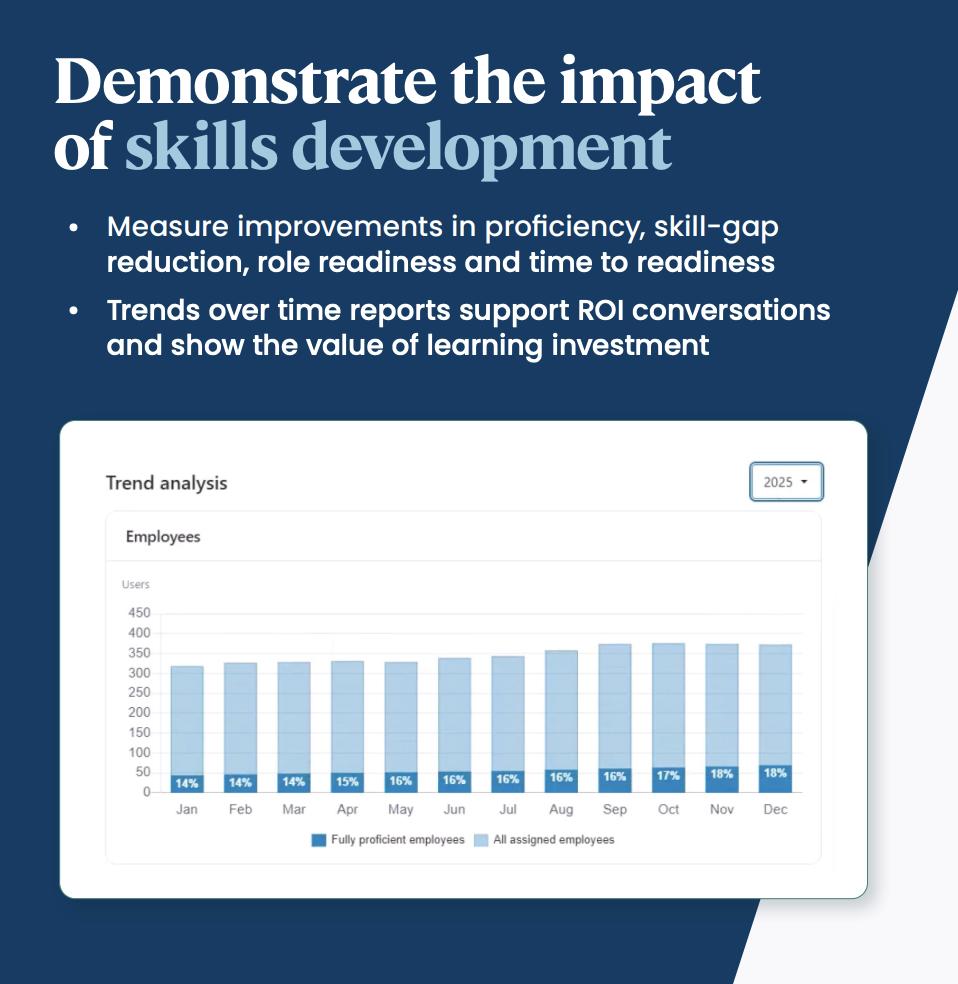
- ✅ Skills profiles and heatmaps: Employees can see their proficiency across required competencies at a glance using their skills profile, while managers can also easily review competency and skills gaps across their team. At the organisational level, L&D teams can use visual heatmaps to identify when users or teams require additional training.
- ✅ Competency roles: Admins can group related skills into sets that can be assigned to different positions, reducing duplication of effort for positions with common competencies. For competencies that are shared across entire teams or departments, this is more efficient than manually assigning each competency to every position.
Together, these capabilities help organisations connect learning activities with demonstrated proficiency, providing a more complete picture of workforce capability than training completion records alone.
Moodle Workplace: Competency-based learning and assessment
Moodle Workplace builds on Moodle’s competency management functionality, making it easier to scale learning and development across larger, more complex organisations.
In addition to core learning features such as programs and certifications, it allows admins to create competency frameworks to facilitate skills tracking and assessment against specified standards.
Key capabilities include:
- ✅ Competency frameworks and proficiency scales: Define the knowledge and skills required for different roles, with configurable scales to assess proficiency, establishing consistent standards across departments and learner cohorts.
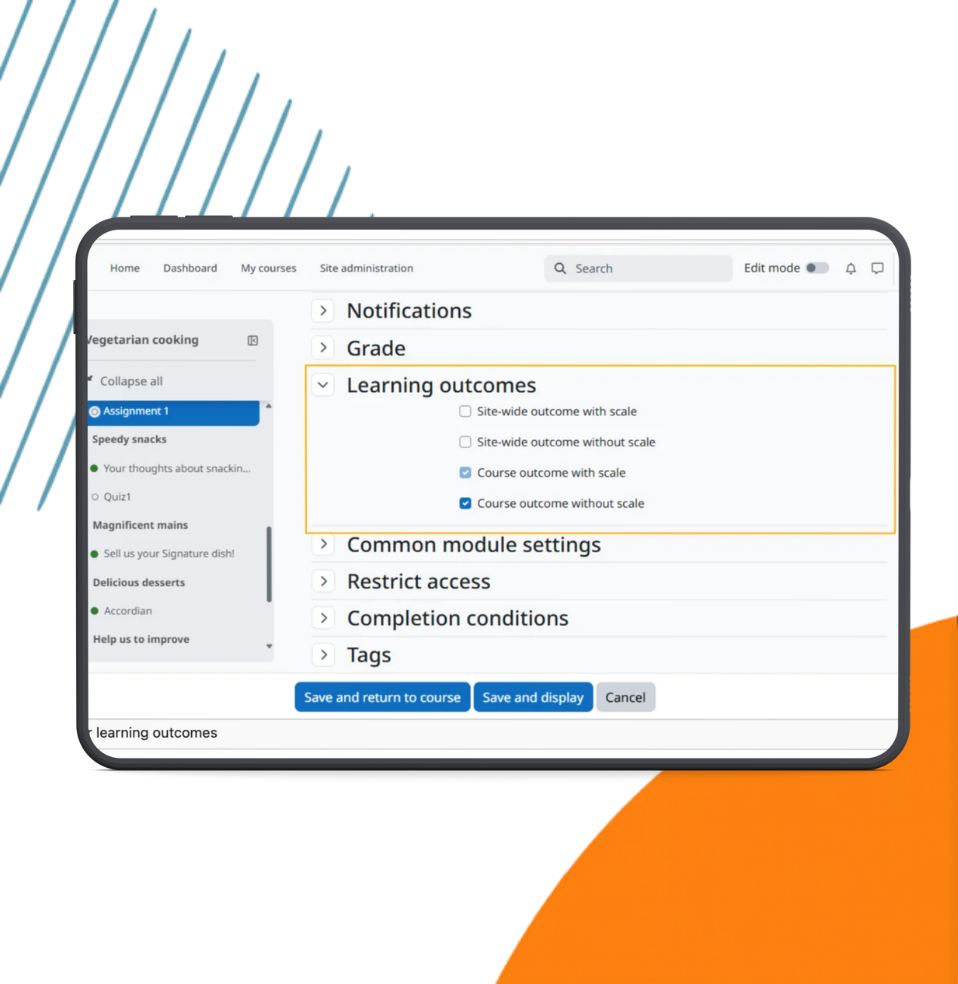
- ✅ Competency-linked learning activities: Map your framework’s competencies to the relevant learning content. Depending on how activities are configured, completing learning activities can automatically mark a competency as complete or flag a competency as ready for an assessor to review.
- ✅ Learning plans: Create structured development plans based on competency requirements, then assign them to individual users or entire cohorts. Users and their managers can conveniently track their progress towards the competencies in each plan
- ✅ Competency assessments: Authorised assessors can manually rate employee competencies against predefined scales, providing an alternative to training completion for demonstrating ability.
- ✅ Evidence of prior learning: As well as completing training in the system, learners can also upload evidence of existing skills, such as external professional certifications, which can then be reviewed as evidence towards competencies within the organisation’s framework.
Alongside Moodle Workplace’s core learning functionality, these capabilities help organisations establish consistent competency standards, and track employee development over time to ensure that learning translates into the skills needed to perform their roles effectively.
Competency management in practice: Customer examples
To help demonstrate how an enterprise LMS supports competency frameworks, we’ll look at how Synergy Learning has helped organisations in highly regulated industries to use these capabilities in practice.
These real examples demonstrate how Totara and Moodle Workplace manage critical training, provide oversight of learning requirements and support practical skills development.
Gas Networks Ireland: Mapping competencies and identifying skills gaps
For organisations operating in safety-critical industries, it’s essential to understand whether employees have the necessary competencies to perform their roles safely. Gas Networks Ireland, which operates Ireland’s national gas network, partnered with Synergy Learning to transform their Totara platform, including the development of a custom training needs analysis tool.
The organisation uses this tool to map competency requirements to individual positions, linking critical skills to each job role.
This provides managers with a clear picture of the skills available across the workforce, and helps to identify skills gaps at the individual and organisational levels.
As a result, Gas Networks Ireland can better target their training and development to build capacity and ensure their workforce is prepared, and provide evidence of competency and compliance to external auditors. Employees can also quickly identify the competencies they need to develop in order to progress their careers and work towards future roles.
This example shows how organisations can move from a standalone competency framework to a practical, LMS-based workforce management tool that connects role requirements to skills development, recording the evidence required for regulated environments.

University Hospitals Birmingham: Responding to changing skill requirements
University Hospitals Birmingham (UHB) needed to rapidly prepare thousands of UK healthcare professionals and volunteers to work at the NHS Nightingale Hospital Birmingham.
As the situation unfolded and requirements changed day to day, training needs and responsibilities also evolved rapidly.
Under extreme time pressure, Synergy Learning worked with University Hospital Birmingham to roll out a Moodle Workplace platform in just six days.
The platform was used to deliver over 60 courses, organised into five different learning pathways, each tailored to various healthcare roles.
Combined with Moodle Workplace’s configurable dynamic rules, the platform automatically assigned training based on the information provided by employees upon registration. This provided an efficient way for doctors, nurses, support staff and volunteers to access relevant learning, develop critical skills and prepare for unfamiliar duties, often outside of their day-to-day skill set.
The project demonstrates how an LMS can translate role-specific learning requirements into structured development pathways, helping organisations respond quickly when operational demands change.

Important considerations for competency management with an LMS
While the right LMS platform provides the tools to manage workforce capability across your organisation, successful implementation requires translating business requirements into practical workflows.
Before setting up an LMS, it’s important to establish how your organisation will define, assess and track competencies and skills development. We recommend considering the following:
- Start with clear competency standards: Identify the essential competencies for each job role, and assign an individual to maintain the competency framework. Depending on your industry, it may also be useful to align your competency definitions with the relevant professional standards or regulatory requirements, so that competencies in the system help to evidence organisational compliance.
- Establish required assessment methods: Decide which evidence is required for each competency (including individual proficiency levels), including where assessments require a supervisor to verify competence through practical observation.
- Connect the LMS with existing systems: An LMS doesn’t exist in a vacuum, so you need to establish how data such as employee records and organisational hierarchies flow between your LMS, HR platform and other systems. For highly regulated industries, reliable and up-to-date data is particularly important.
- Define reporting and governance: Establish which users (e.g. admins and auditors) need access to specific data, how long evidence is retained in the system and who is responsible for approving competency assessments. Data protection requirements should underpin each of these decisions.
- Plan for ongoing changes: Competency frameworks need to be dynamic, adapting in line with changing operational practices, industry regulations and professional standards. This means establishing a process for regularly reviewing and updating competency requirements.
An experienced LMS implementation partner such as Synergy Learning can help organisations work through these decisions and configure the platform based on their specific operational needs.
Building a more effective approach to competency management
Developing a competency framework is the first step in managing competencies effectively to ensure that you’re in line with your industry’s regulations and professional standards.
However, the real challenge is in putting those standards into practice. An enterprise LMS does a lot of the heavy lifting by linking competencies with job roles, automating the assignment of relevant learning, outlining consistent assessment methods and timeframes, and providing reliable reporting and record-keeping. With the right implementation partner to guide you through these decisions, you can configure a platform that provides greater visibility into workforce capability while reducing the administrative burden.
Both Totara and Moodle Workplace provide valuable features for implementing competency frameworks and assessing competency for organisations in regulated sectors. The right choice of platform will depend on your organisational and regulatory requirements, as well as your broader learning strategy.
As a certified Totara and Moodle partner, Synergy Learning helps enterprise organisations design, implement and optimise learning management systems around their specific requirements.
If you want to see how an LMS can help manage competencies more effectively in your organisation, get in touch with our team of specialists.