16 January 2026
Why does learner engagement matter in 2026?

Natalie Holborow
Content Manager
Hot topics in workplace learning come and go, but in the 20-plus years we’ve been consulting and designing LMS solutions, there’s one topic that remains a permanent fixture on every L&D professional’s priority list: learner engagement.
What is learner engagement?
In simple terms, learner engagement is the active, purposeful involvement of learners in the learning process. When learners are engaged, they are connecting, applying and valuing the learning experience (as opposed to passively consuming content; we’ve all skipped through slides of uninspiring text at some point in our working lives).
Learner engagement shows up as a combination of the following:
- ✳️ Emotional connection – does the individual see the value in learning?
- ✳️ Cognitive investment – are they thinking critically, making decisions and applying knowledge?
- ✳️ Behavioural action – are they completing modules, revisiting resources or collaborating with others?
We all want higher levels of engagement in our learning and development programmes. Higher learner engagement drives better learning outcomes, which supports wider business goals and makes it easier for L&D to gain buy-in. Most importantly, increased learner engagement maximises the opportunities for people to improve both themselves and the organisation as a whole.
Why does learner engagement matter in 2026?
According to the most recent LinkedIn Workplace Learning Report, an unsurprising 91% of L&D pros agree continuous learning is more important than ever for career success. In the same report, data shows that companies with strong support for internal growth have more employees actively engaging with learning, along with higher promotion rates and stronger leadership pipelines. This is a solid example of how business performance increases in line with learner engagement levels.
So, why else does learner engagement matter so much today?
1. Increased learner engagement drives skills development
The most recent Fosway report shows that, for the first time, upskilling and reskilling topped the list of learning priorities for the year, finally overtaking compliance. But what does this have to do with learner engagement?
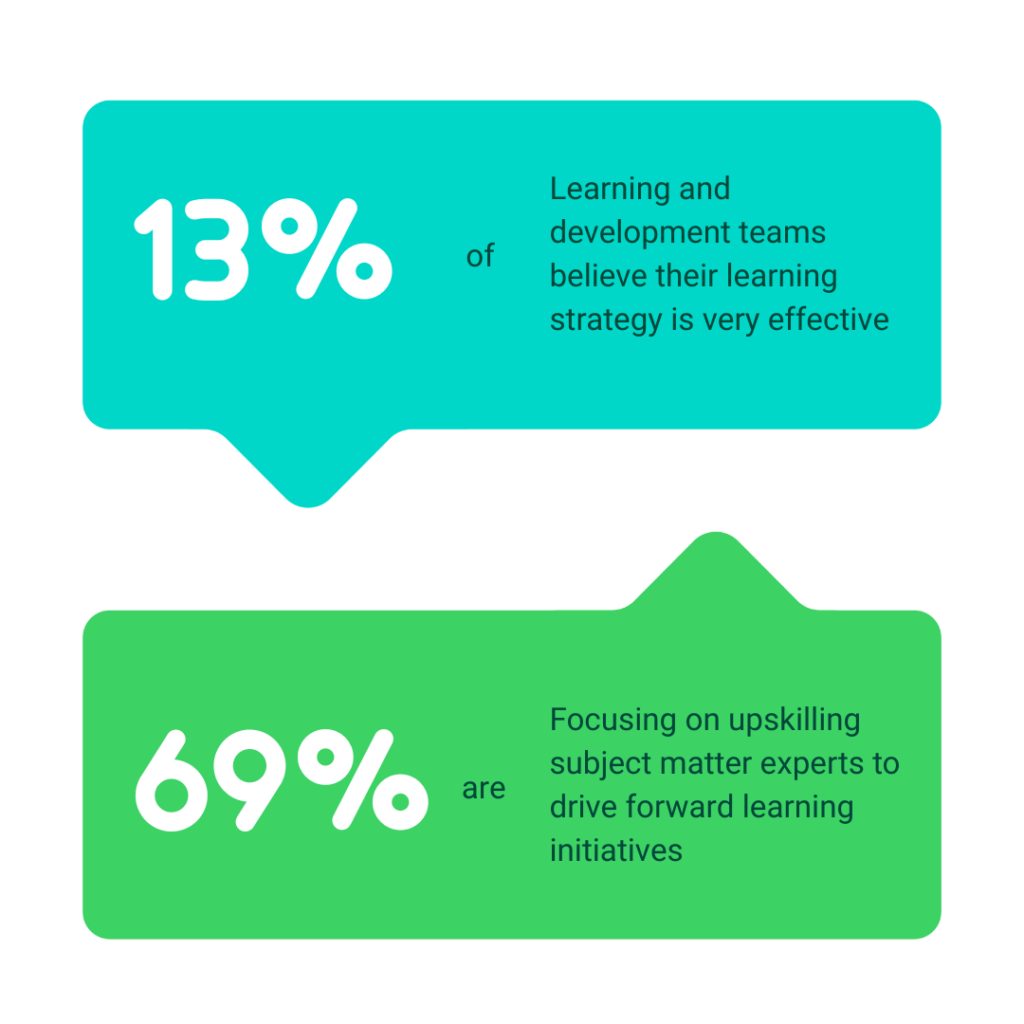
In this report, it was revealed that:
- ✳️ Only 13% of L&D teams believe their current learning strategy is very effective at building skills.
- ✳️ 69% are focusing on upskilling subject matter experts to drive forward learning initiatives.
It’s also been found that companies that prioritise career development and internal mobility see far higher levels of learner engagement; this means their employees are not only more likely to participate in learning, but they’re also more likely to develop the business-critical skills needed to thrive in new roles. This connection between engagement and upskilling is essential if you want to build a future-ready workforce, support internal mobility and reduce recruitment costs (by developing talent from within).
According to the World Economic Forum, 50% of all employees will require reskilling by the end of this year. Getting employees on board and engaging with learning starts now.
2. Engagement fuels a strong learning culture
Is learning an active part of daily working life for everyone in your organisation? Is it a continuous process that’s integrated with work? Do people feel safe to try, fail and learn from it?
A learning culture is an environment where employees are encouraged to continuously develop their skills, knowledge and capabilities as part of their working life. It has a direct and meaningful impact on several critical areas, including retention, profitability, productivity and wellbeing. While a learning culture isn’t something that can simply be built overnight, the payoff is worth the effort – in fact, companies with strong learning cultures have a 7% higher rate of promotions to management, 23% higher internal mobility rate and 57% higher retention rate than those where learning is less robust (LinkedIn Workplace Learning Report).
Engagement is key to building a strong learning culture. Some steps you can take towards this include:
- ✳️ Support a growth mindset
- ✳️ Make your leaders your learning champions
- ✳️ Encourage peer knowledge sharing
- ✳️ Foster psychological safety for learning
- ✳️ Measure and reward learning outcomes
Explore more on how to successfully build a strong learning culture.
3. Engagement drives LMS success
A learning management system alone doesn’t guarantee learning impact. You can have the most advanced LMS or LXP on the market, but if people aren’t engaging with the learning content in a meaningful way, the system simply becomes another checkbox tool rather than reaching its full potential.
What is your LMS data telling you about learner engagement? Perhaps login numbers reveal that people are logging in but not completing courses. Or, perhaps they are completing courses but never returning to engage with peers post-training. Often, this isn’t down to a technology issue but rather a learner engagement issue.
You might have all the newest features built into your state-of-the-art LMS, but learner engagement is what transforms your technology from a content repository to a performance driver. When learners are motivated and can see how learning connects to their goals and see the LMS as a central hub to make this learning happen, this drives those repeat LMS logins.

To make your LMS successful in driving learner engagement, focus on:
- ✳️ Curating relevant, role-specific content
- ✳️ Creating personalised learning journeys based on skills and career paths
- ✳️ Using your LMS data to identify drop-off points and adapt quickly
- ✳️ Integrating learning into the daily flow of work
LMS success is measured by engagement, application and outcomes. This starts with designing learning experiences that people actually want to be part of.
Common barriers to learner engagement
Low learner engagement is usually the result of unmet expectations, irrelevant content or poor user experience. If your learners are dropping out or failing to show up in the first place, this is usually a sign that something isn’t working. Here are some common reasons for low learner engagement.
1. The learning content lacks relevance or context
If learners can’t see how the content connects to their role, goals or day-to-day work, they’ll fail to engage with it. Why should they take time out of their busy day-to-day activities to dedicate time to learning if they can’t see the point of it?
“Why am I doing this?” is the question you need to answer for them. Here are some tips on how to demonstrate the relevance of learning content effectively:
- ✳️ Start with the learner’s job, not the subject – Design training around what learners actually do and not just what they need to know. Focus on the tasks, workflows and decisions they face daily.
- ✳️ Tailor learning pathways to roles or career stages – Use an LMS such as Moodle or Totara to segment learning pathways by function, department or level of seniority. For example, a new team leader and a senior manager might have very different approaches to the same topic (e.g. performance reviews).
- ✳️ Start with the “why” before the “how” – Involve line managers in this. They can help individuals understand how the learning will help them move closer to their goals. Is it tied to upskilling, promotion pathways or internal mobility?
- ✳️ Let learners self-direct – Most LMS platforms will now offer smart recommendations, but allow for flexibility too. What are peers recommending, for example? When learners have some control over what and when they learn, they’re far more likely to engage.
2. Learning experiences are poorly designed
Lengthy, text-heavy modules or bloated, hard-to-navigate content repositories can quickly lead to cognitive overload and learner drop-off. It’s probably not news to you that research has shown that human attention spans have drastically decreased from 12 seconds to 8.5 seconds, making those long, non-interactive learning formats increasingly ineffective.
Today’s learners need access to digestible information they can apply immediately – ideally when and where they need it. This is especially true when we consider that LMS modules are constantly competing with emails, meetings and tasks in the flow of work.
If your LMS theme is feeling clunky or uninspiring, Synergy Learning customers can opt for the exclusive Spark LMS theme, purpose-built for Moodle and Totara platforms. It goes beyond just providing a “skin” for the system – it’s designed to drive engagement through thoughtful design, intuitive design and learner-centred functionality:
- ✳️ Intuitive content creation – Create beautiful, UX-focused pages and shape learning experiences with an easy-to-use interface and visual builder.
- ✳️ Bespoke feel (minus the price tag) – Immerse your learners in the full brand experience with a learning platform that looks bespoke, but is achievable within any budget.
- ✳️ Personalised experiences – Dynamic displays such as upcoming courses, recently accessed content and recommended resource lists help learners feel the LMS is tailored and relevant to their needs.
- ✳️ Motivating insights and prompts – Spark includes progress visuals and leaderboards, driving motivation as people progress through the learning journey.
- ✳️ Mobile-friendly and responsive design – Consistent experiences across devices make it easier for learners to engage on the go.

3. Lack of follow-up or application
We’ve previously explored the importance of learning transfer, which occurs when “an individual understands a concept, skill, theory or domain of knowledge to the extent that he or she can apply it appropriately in a new situation” (Garner, 1999). Learning shouldn’t just end when the module does, yet too often, training is treated as a one-off event or a box-ticking exercise.
However, according to Ebbinghaus’s Forgetting Curve, learners forget up to 70% of new information within 24 hours if it isn’t reinforced. Even the most engaging LMS experience won’t deliver lasting impact unless it’s backed by ongoing support, real-world context and opportunities for the individual to reflect and apply what’s been learned. This is where many learning journeys fall short:
- ✳️ No time or space for practice
- ✳️ No manager involvement to reinforce new behaviours
- ✳️ No performance feedback loops
- ✳️ No cultural expectation to apply what’s been learned
When there’s no system in place to encourage learning transfer, learners disengage and fail to apply what they’ve learned. This is why learning journeys must be clearly connected to day-to-day performance.
So, how can you overcome this challenge? Here are a few tips:
- ✳️ Involve managers from the start – Encourage managers to have pre- and post-training conversations and help them understand their role in reinforcing new skills on the job.
- ✳️ Build in post-learning nudges – Use automated LMS reminders, email prompts or spaced repetition techniques to revisit key concepts over time.
- ✳️ Integrate real-world tasks – Design assessments or follow-up activities that require learners to apply new skills in their current role (line managers can help here to observe the successful application of new skills).
Use peer accountability – Set up learning groups, discussions or feedback spaces in your LMS to encourage continuous dialogue and maintain engagement.
Ready to drive learner engagement in 2026?
Book a meeting to discuss how learning technologies, better UX design and smarter learning content will overcome your learner engagement challenges.