5 August 2025
Your LMS Demo Checklist & Scorecard
Explore all the things you need to consider when buying a learning platform with the help of our LMS demo checklist.
Are you getting ready for an LMS demo as your organisation prepares to buy a learning management system? With so many learning platforms from which to choose, a demo is a great way of separating the wheat from the chaff.
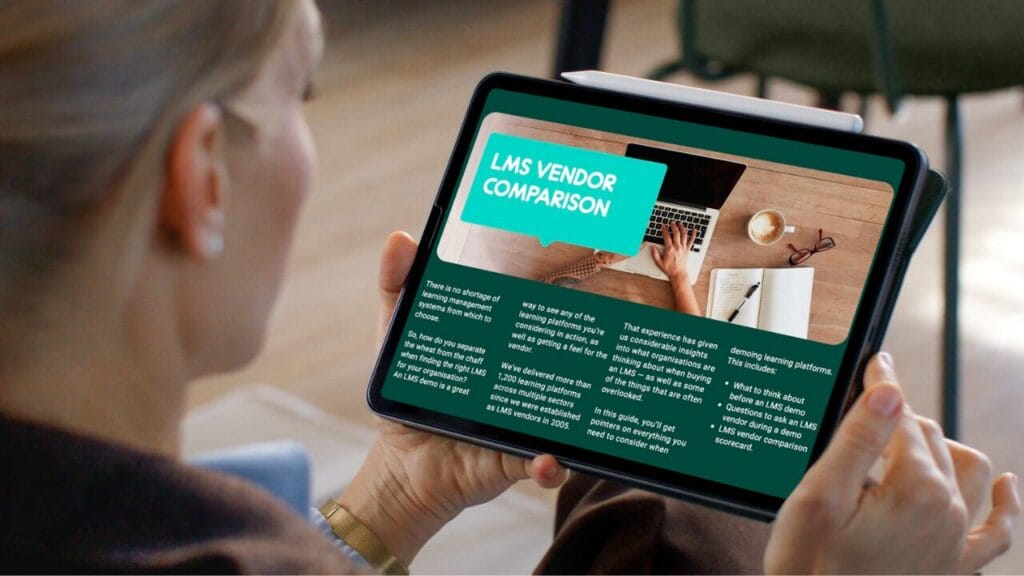
An LMS demo is a great way to see any of the learning platforms you’re considering in action, as well as getting a feel for the vendor.
We’ve delivered more than 1,200 learning platforms across multiple sectors since we were established as LMS vendors in 2005. That experience has given us considerable insights into what organisations are thinking about when buying an LMS — as well as some of the things that are often overlooked.
In this article, we’ll share pointers on everything you need to consider when demoing learning platforms. This includes:
- What to think about before an LMS demo
- Questions to ask an LMS vendor during a demo
- LMS vendor comparison scorecard
What to think about before an LMS demo
To get the most value from any LMS demo, you need to have some things clear in your mind beforehand.
Going into the demo with an understanding of these key factors will help you to brief LMS vendors effectively and get more relevant information from the demo.
The key areas to think about before your LMS demo are:
Budget
How much do you want to spend on your new LMS? Is this figure fixed, or would you stretch your LMS budget for a platform that would deliver greater efficiency savings?
Project team
Who is involved in choosing your LMS? Is this a decision for the HR or L&D team? Do senior management, IT or other departments need to have an active role?
If so, should any of them be involved in the demo? Even if they don’t need to join the demo, it’s worth making sure you have a firm understanding of their involvement and priorities.
Priorities
Have clear in your own mind the outcomes that you need your new LMS to deliver. What would a successful LMS look like? How could this be measured?
Understanding your priorities helps to build the business case for investment, narrow down the search for the right LMS and determine KPIs for the project.
Existing infrastructure
Build your understanding of the existing software and systems in use across your organisation.
Talk to IT and other departments to create a detailed list of existing infrastructure. This will help to establish how your LMS can integrate with other platforms.
Timelines
Decide on project timelines so that all stakeholders understand the schedule you’re working towards.
This will help with every stage from planning the timing of demos through to setting a deadline for the new LMS to go live.
Questions to ask an LMS vendor during a demo
Our must-ask questions for any LMS demo will help guide you towards the right platform for your organisation’s needs.
What can you achieve within my LMS budget?
You’ll have a wish-list of what you want your LMS to do, and you’ll also have a budget to spend. The temptation is to keep quiet about the budget and try to get as close to what you’re after before the price gets too high.
But why not turn the tables on LMS vendors? Be upfront about how much you’re able to spend, then put the onus on each vendor to detail what they can achieve within your budget.
What are your LMS storage tiers or prices?
Build your understanding of how pricing works now, but also how it could change in the future. If your organisation grows or if you need to store large files on your LMS, will this increase the amount you pay?
The last thing you want is to go ahead with an LMS that sounds like good value and then be hit with unexpected charges down the line.
How many LMS users can I have?
Similar to the point about storage tiers, many LMS platforms have pricing tiers with a maximum number of users. Find out if any LMS you’re considering has a maximum number of users, as well as checking on the limits for each tier.
If your organisation has plans to grow or if you’re close to the threshold for a price increase, this is worth considering at the outset.
Is this LMS scalable?
Does the platform have the flexibility to grow — or shrink, if needed — with your organisation?
It’s a good idea to know in advance how easy it is to move between pricing tiers or make any other changes needed to scale your platform.
Will my LMS integrate with other systems?
Find out how easily a platform will connect with the systems already in use across your organisation. LMS integrations can help you to save admin resources, streamline sign-on and increase engagement.
Ask the vendor how these integrations will work with a view to increasing LMS automation, removing duplication and sharing data across your organisation.
Can this LMS do x?
Any organisation has make-or-break features. Yours will be no exception. Ask about these during the demo because there is no point getting further down the line and finding out a vendor can’t deliver the functionality you need.
It’s worth listening to ‘no, but…’ answers, too. Sometimes there are easier or better ways to achieve the same outcomes. A vendor might suggest an alternative approach that delivers the results you need.
What is your estimated LMS turnaround time?
Find out whether a vendor is going to be able to deliver your new LMS to the timelines you need.
You need to have confidence that your LMS project will stay on schedule.
What are your LMS quality assurance processes?
Any LMS vendor will be capable of getting a new platform live. So a key consideration is what shape the platform will be in when it goes live.
Ask a vendor to detail their LMS quality assurance processes. What measures will they take to ensure your platform is free from bugs and working as expected for your learners and admins?
How does LMS hosting work?
Ask the vendor what LMS hosting options are available to you, whether there are any additional costs involved and what this entails.
Check on guaranteed uptime, find out what monitoring processes are in place, and see how regularly your hosting infrastructure would get maintenance, software and security updates.
What LMS support do you provide?
Ongoing support for every aspect of your LMS is essential to its success. When something goes wrong or you get stuck, how quickly can you expect to get the help you need?
Ask about LMS support processes, response times and any limits on the amount or frequency of support available to you.
Have you worked on similar LMS projects?
Find out whether an LMS vendor has the experience needed to deliver the results you want.
Ask to see examples of LMS projects of a similar size or platforms with similar goals or functionality to your own.

Ready to talk about your LMS project?
Synergy Learning deliver award winning LMS platforms that reduce training costs and increase learner engagement.
Schedule a call to discuss your project and discover what Synergy Learning can build for you.
- What to think about before an LMS demo
- Questions to ask an LMS vendor during a demo
- LMS vendor comparison scorecard
What should you consider after your LMS demo?
After a demo, it’s a good idea to think about how the LMS you’ve seen matches up against other contenders.
Here are all of the key areas in which you need to compare vendors. Let’s explore what they mean and why they’re important.
UX & UI Experience
How your LMS looks and how learners interact with it will play an important role in its success. User experience and user interface design have a significant impact on engagement levels — and that means it has the potential to make or break your LMS.
Reporting & Analytics
The answers to most questions about how to improve your L&D programme can be found in your LMS data. That’s why you need to build your understanding of how an LMS vendor can help you to access, analyse and share key insights from the platform.
Integration Capabilities
A good LMS creates efficiency savings that ultimately stretch your budget. Those efficiencies increase when your learning platform is connected to other software and systems used in your organisation. Establish how effectively an LMS will integrate with other platforms.
Admin Ease of Use
Automation and other intuitive admin features can save a lot of time and resources that would otherwise be spent managing your LMS. Compare how different platforms will make life easier and free up time that can be better spent elsewhere.
Pricing Transparency
Do you know exactly how much a particular LMS will cost? You want straight answers about pricing, including any possible extras, add-ons or tier changes that could impact your budget over time. Be wary of vague answers.
Support & Onboarding
Even the most intuitive LMS is a new platform for your L&D team to get used to. A clearly defined process for onboarding will help to get everyone up to speed quickly. Get answers about the speed and nature of the support available if any issues arise over time.
Security & Compliance
What steps does each LMS vendor take to keep your organisation safe from cybersecurity threats? You must have confidence that a learning platform will meet your GDPR and regulatory requirements, while also protecting your infrastructure from hackers and viruses.
Get your LMS demo scorecard

Download our LMS demo scorecard to evaluate and compare LMS vendors with clarity and confidence.
Simply fill out the form to get started.