
14 November 2025
Using your LMS to create upskilling programmes that increase employee retention and productivity

Natalie Ann Holborow
Content Marketing Manager
Upskilling programmes are a powerful tool for any organisation to have at its disposal. They are one of the most effective ways for any employer to keep its employees happy, motivated and productive.
Creating a culture of continuous improvement equips your team with the skills they need to adapt to your organisation’s changing needs and to further their own careers. That’s why an effective upskilling programme benefits everyone.
Let’s look at five of the key ways upskilling programmes support both L&D and wider business goals by reducing staff turnover and boosting productivity.
Upskilling programmes increase job satisfaction
A successful upskilling programme can directly impact job satisfaction across an organisation. An organisation that is proactively involved in upskilling shows itself to be invested — and investing — in each employee’s growth.
An employee who feels valued and is engaged in upskilling is less likely to leave the organisation. A Gallup survey found that engaging employees results in 21% less employee turnover at high-turnover organisations and 51% less employee turnover at low-turnover organisations.
Crucially, employees are also likely to be more productive as a result of engagement through upskilling programmes. The same Gallup research revealed that highly-engaged employees result in 14% higher productivity and 78% less absenteeism.
Across your whole organisation, that can amount to a significant impact on profitability.
Upskilling programmes promote career progression
Employees who are engaged in an upskilling programme have a clear career path set out for them. This could be a path towards promotion and senior roles related to their current roles. Alternatively, it could be a plan to develop new skills that will open up more opportunities to them.
In either case, employees are less likely to move on when they have a clear vision of their future with the organisation. As well as outlining future promotion opportunities, this infrastructure encourages internal promotion. This delivers financial benefits for the organisation by reducing recruitment and onboarding costs. It also ensures a self-fulfilling cycle of career progression. With internal promotion the norm, your people expect and seek out career progression opportunities, which further reduces staff turnover.
A study in the International Journal of Research in Human Resource Management found that career path transparency combined with employee engagement results in a 31% variance in turnover intent. This indicates just how powerful an upskilling programme that highlights career progression opportunities and engages employees can be.
Using a learning management system based on competency frameworks gives the infrastructure to apply — and even automate — upskilling that is directly linked to career progression across your organisation.
Upskilling programmes drive competency (which drives productivity)
A thriving upskilling programme makes your employees more competent and more confident. Equipped with the skills they need to perform their roles, and safe in the knowledge that they have the training to do their jobs effectively, productivity inevitably increases.
McKinsey has described investing in frontline talent as “the missing productivity ingredient”. It points to an electronic-component manufacturer — one of 56 included in the study because they perform better than their sector average in terms of total shareholder return (TSR) and labour productivity growth. The manufacturer achieved double-digit increases in its number of internal promotions by designing a custom training programme to equip workers with the right skills to advance their careers.
Another McKinsey study found that hiring for or developing the right skills in an employee is around five times more predictive of how well someone will perform in their role than their education and two times more predictive than their existing work experience.
Upskilling programmes encourage loyalty
By targeting the development of skills that are most important to your organisation’s success, your upskilling programme can help to build organisational culture.
An upskilling programme underpinned by clear and transparent competency frameworks — detailing which skills are needed in each role, and to what degree — provide a structure that will nurture both continuous improvement and organisational culture.
A culture of trust, inclusion, transparency, shared values and organisation-wide growth — coupled with the clear career progression pathways we previously discussed — helps people to feel valued and to feel that their development is valued. Deloitte states that a strong learning culture drives “decreased employee turnover, as employee satisfaction grows and loyalty and commitment strengthens”.
As we touched on in relation to job satisfaction, employees who feel valued are more likely to remain loyal to the organisation. A Gallup study found that employees who strongly agree that their employers encourage them to learn new skills are 47% less likely to be searching or watching for another job.
Increasing loyalty among your workforce can significantly reduce staff turnover, which lowers recruitment and onboarding costs. Limiting the churn of employees also builds productivity by maintaining stability, increasing cohesion and removing unnecessary lulls caused by people leaving and new starters finding their feet.
Upskilling programmes reduce skills gaps
The presence of an organisation-wide upskilling programme builds the infrastructure and instils the agility to respond to emerging skills gaps — and even to close skills gaps before they’ve had a chance to emerge.
Directly linking workforce capabilities and competencies with current and future business needs means your organisation is more adaptable and better equipped to pivot to emerging priorities, technologies and markets.
The inevitable consequence is that productivity is enhanced and can be maintained even during times of change or transformation. This is not just a desirable business outcome; it also makes economic sense.
A McKinsey report states that upskilling and retraining to address skills gaps is financially beneficial for UK organisations in 75% of cases. The same analysis says that reselling brings a productivity uplift of between 6 and 12%.
Having existing internal capabilities to adapt as and when needed, rather than hiring or retraining on an ad hoc basis, builds resilience and future-readiness. With powerful LMS reporting and analytics, you instantly have a wealth of data available to inform which skills gaps to address and to monitor emerging skills gaps.
Learner data also helps you to identify the employees with the competencies or experience best-suited to being upskilled or reskilled to meet organisational priorities.
Using an LMS to manage an upskilling programme
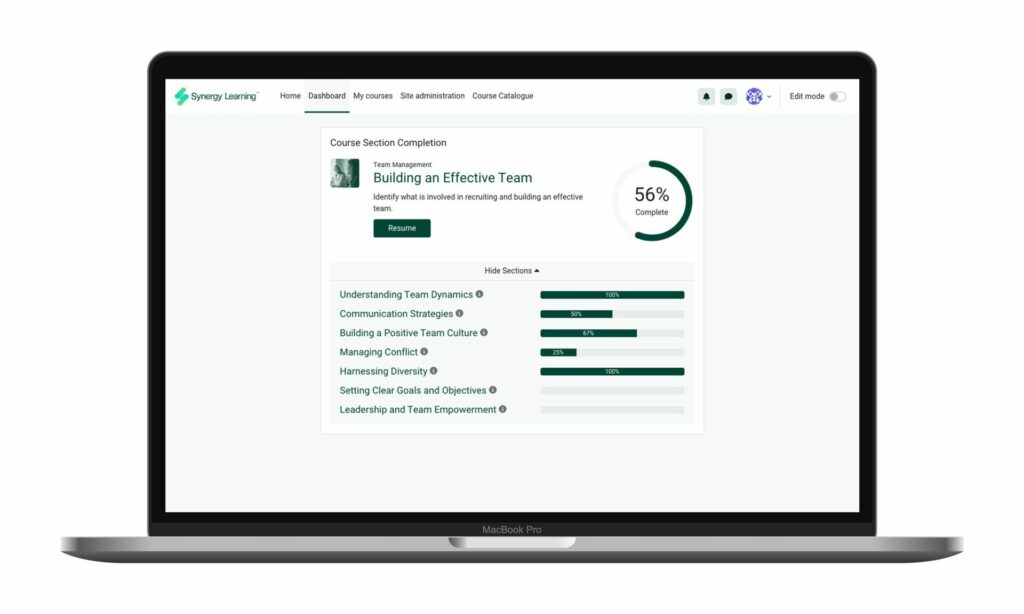
A Learning Management System gives you all the tools you need to create, manage and deliver an effective upskilling programme. The competency frameworks within your LMS detail which skills are needed for each role. This provides meaningful focus for upskilling.
Using automated learning pathways, your Learning management platform will direct each employee to meaningful, relevant learning that expands their skillset and supports career progression. By integrating with a performance management system, you can ensure that each employee and their manager are involved in shaping this progression.
Finally, using your LMS reporting system, you can easily monitor upskilling priorities on an individual, team and organisational level.
Reduce employee turnover and boost productivity at your organisation
Ready to create an upskilling programme using your LMS? Talk to our learning technology experts about how you can keep your team engaged, productive and loyal.
Get in touch, we’d love to chat through what success looks like for you and how we can work together to achieve it.